Mailchimp Acquisition: What Mailchimp Users Should Expect

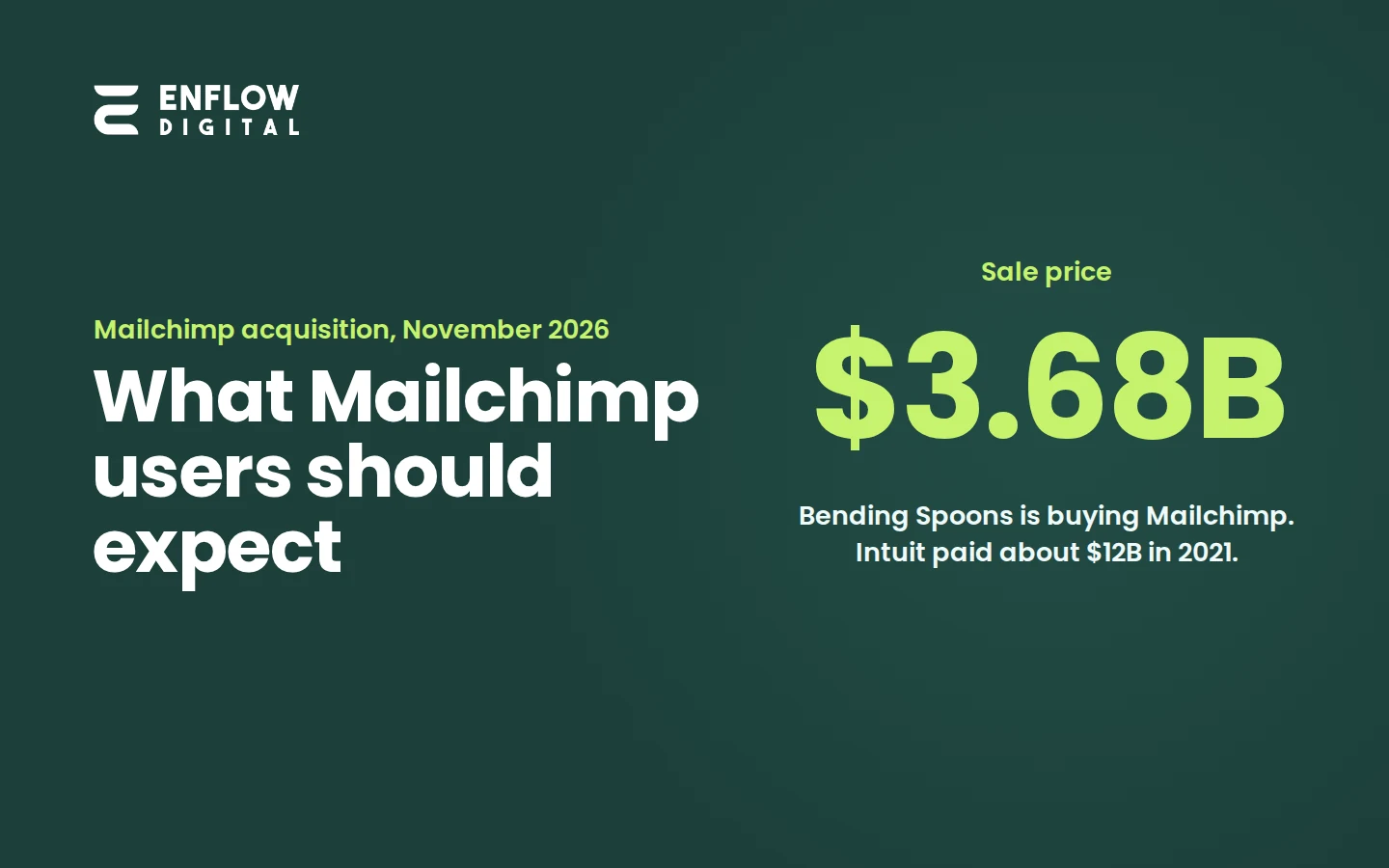
The Mailchimp acquisition hands your email platform to Bending Spoons. Bending Spoons has a record of cutting staff and raising prices at the products it buys. The $3.68 billion deal with Intuit was announced on 19 November 2026 and should close in early 2027. If you use Mailchimp, prepare now.
This page is written for the Mailchimp user who wants to know what is coming. Deal facts come from the Bending Spoons press release and Intuit's announcement, read on 20 November 2026. Reports about prices and layoffs link to the page that published them, and we say so when a company has not confirmed a report.
Key takeaways
- Bending Spoons agreed on 19 November 2026 to buy Mailchimp from Intuit for $3.68 billion. The deal should close in early 2027.
- At Evernote, WeTransfer, Meetup, Komoot, Harvest and Vimeo, the same owner cut staff, raised prices or shrank the free plan.
- Mailchimp was already charging more for less under Intuit. Automations left the Free plan in 2025, and the Free plan was halved in 2026.
- Do not wait for the price email. Export your Mailchimp data in December and have a migration plan ready before the deal closes.
The Mailchimp acquisition at a glance
| Question | Answer |
|---|---|
| Who is buying | Bending Spoons, a technology company from Milan, Italy, listed on Nasdaq (press release) |
| Who is selling | Intuit, which paid about $12 billion for Mailchimp in 2021 |
| Price | $3.68 billion: $3.31 billion in cash and $368 million in Bending Spoons stock (Intuit) |
| Announced | 19 November 2026 |
| Expected close | Early 2027, once regulators approve the deal |
| Mailchimp revenue | $313 million in the quarter to 31 October 2026, down 1% on a year earlier |
| What changes today | Nothing. Intuit runs Mailchimp until the deal closes |
| What we expect after closing | Staff cuts, higher prices and a stalled roadmap, as at the buyer's other products |
Our view, disclosed. Enflow Digital migrates ecommerce brands between email platforms, and moves off Mailchimp to Klaviyo or Omnisend are a regular part of that work. We are a partner agency of Brevo, Klaviyo, Omnisend and Shopify, and some of these programs pay us a commission when a business we refer signs up. We also audit Mailchimp accounts, and we tell a brand to stay when its numbers say so.
Should Mailchimp users worry about the acquisition?
Yes, Mailchimp users should worry about the acquisition. After Bending Spoons took over, most of the staff left Evernote, WeTransfer and, by press reports, Komoot. Prices rose at Evernote, Meetup, Harvest and Vimeo. Neither Bending Spoons nor Intuit has promised Mailchimp users anything on prices, staff or the roadmap.
Mailchimp users are already saying it. "Somehow a worse owner than Intuit," wrote one commenter on Hacker News. Lex Roman of Revenue Rulebreaker expects that "Bending Spoons will cut staff, reduce the feature set and raise prices".
The two announcements do nothing to calm that worry. Luca Ferrari, the CEO of Bending Spoons, says that after closing "we'll invest substantially in the business". Jack Tam of Intuit says the focus is "a smooth transition for Mailchimp's customers, partners, and employees". Neither names a price, a headcount or a product plan.
One thing protects you for now: nothing changes until the deal closes. Intuit still runs Mailchimp, so logins, billing, automations and store integrations work as before. The announcement came 8 days before Black Friday, so finish peak season on Mailchimp.
Who owns Mailchimp now?
Intuit owns Mailchimp until the sale closes. Bending Spoons signed a definitive agreement to buy Mailchimp on 19 November 2026 and expects to complete the purchase in early 2027. Until regulators approve the deal, Mailchimp stays part of Intuit, the company behind QuickBooks and TurboTax.
Intuit bought Mailchimp in 2021 for about $12 billion. Intuit is selling Mailchimp for less than a third of that price.
Intuit had stopped investing before the sale. In May 2026, Intuit cut about 17% of its workforce. Its CEO wrote that Intuit was "reducing investments in certain areas, including Mailchimp" (Intuit). MarTech put it more bluntly: Intuit "was essentially running the business for the cash flow".
Mailchimp revenue shows the result. Intuit expects $1.256 to $1.266 billion for the fiscal year, flat to 1% down.
What is Bending Spoons?
Bending Spoons is a technology company from Milan, Italy, that buys established digital products and runs them itself. Bending Spoons owns Evernote, WeTransfer, Vimeo, AOL, Eventbrite, Airtable and Miro. Its shares have traded on Nasdaq under the ticker BSP since 1 July 2026.
Bending Spoons states its method in the Mailchimp press release. A typical takeover reorganizes teams, rebuilds the technology, redesigns the interface and speeds up product work. It also changes marketing and monetization (how the product earns money).
Mailchimp is its largest purchase so far, according to Trending Topics. Bending Spoons says it has never sold a material business it bought. Mailchimp users should not expect a quick resale. They should expect the method.
Bending Spoons acquisitions: what happened to staff and prices
After each of the six Bending Spoons acquisitions below, prices or plan limits changed, usually within a year, and at five of them staff were cut. Where a company has not confirmed a figure, the table says who reported it.
| Product, deal closed | Staff | Prices and plans |
|---|---|---|
| Evernote, January 2023 | 341 full-time staff at the acquisition, 60 at the end of 2024 (Bending Spoons prospectus). Most US and Chile staff were laid off in July 2023 (Evernote). | The Personal plan went from $70 to $130 a year (CNBC). The free plan was capped at 50 notes (Evernote). |
| Meetup, January 2024 | The US team was cut in February 2024 (Meetup). | Organizer prices rose in June 2024 (Meetup). Costs for organizers more than doubled, reports Follow the Money. |
| WeTransfer, July 2024 | Bending Spoons confirmed a plan to lay off 75% of staff (TechCrunch). | The free plan was limited to 10 transfers a month (TechCrunch). New terms in July 2025 raised fears that user files could train AI. WeTransfer removed the wording after a backlash (TechRadar). |
| Komoot, 2025 | Up to 85% of 150 staff were reportedly laid off. Komoot confirmed a layoff but not its size (BikeRadar). | A redesign in September 2025 came with a price increase (BikeRadar). |
| Harvest, July 2025 | No report found. | Usage-based pricing took one UK customer from $130 to $2,110 a month. A US customer went from $2,800 to $23,000 a year (BBC). |
| Vimeo, November 2025 | "Most" of the staff were laid off in January 2026, by former employees' accounts (Gizmodo). Bending Spoons confirmed a layoff but gave no number. | Some customers were moved to a plan costing 5 times more (PetaPixel). Reddit users reported price notices up to 2,400% higher (Net Influencer). |
Bending Spoons does not hide the method. Luca Ferrari told Follow the Money that "with a smaller, more talent-dense team, we will be able to do more, faster and better". He also said: "I agree that we often increase prices for users who use an application most frequently."
Read that second line as a Mailchimp user. A store that mails 50,000 contacts three times a week is the frequent user he means.
In fairness, none of these six products has shut down, and Ferrari says their user numbers are "stable or growing". Bending Spoons does not publish those numbers.
Will Mailchimp raise prices after the acquisition?
Expect Mailchimp prices to rise after the acquisition. No price change has been announced, and Bending Spoons cannot set Mailchimp prices before the deal closes. But prices rose at Evernote, Meetup, Harvest and Vimeo, and Mailchimp was already charging more for less under Intuit.
Mailchimp users have seen three squeezes since mid-2025:
- Mid-2025: automations left the Free plan. Mailchimp retired its classic automation builder in June 2025 (EmailOctopus). Automations were taken off the Free plan (Audienceful).
- February 2026: the Free plan was halved. The Free plan went from 500 contacts and 1,000 sends a month to 250 contacts and 500 sends on 17 February 2026. Price Timeline published the email Mailchimp sent to users. Mailchimp's help page shows the new limits.
- April 2026: older paid plans went up. Accounts created before May 2019 have paid 11% to 13% more on average since 13 April 2026, according to EmailOctopus and ActiveCampaign. Mailchimp has published no notice of this rise, and both reports come from rival email platforms. Check your own invoices.
Write down three numbers now: your monthly Mailchimp bill, your contact tier, and the share of store revenue that email brings in. A pricing email is easier to judge against those three numbers.
What the Mailchimp acquisition means for the product
Expect the Mailchimp product to stall first and change later. Three phases lie ahead: a wait until the deal closes, a reorganization after closing, and then a new direction. Ecommerce stores should not count on new Mailchimp features during 2027.
- Now to early 2027: waiting. Intuit cut its investment before the sale and has no reason to restore it. Bending Spoons cannot direct anything until closing.
- The months after closing: reorganization. WeTransfer's layoff plan came less than 6 weeks after its deal closed. Vimeo's layoffs began about 2 months after closing. Expect slower support, because the people who know how the Shopify sync behaves may be gone.
- Later in 2027: a new direction. Bending Spoons says it will invest, and that AI is often central to its plans. Nobody outside Bending Spoons knows where ecommerce features rank on its list.
One risk gets too little attention: deliverability (whether your emails reach the inbox). Most Mailchimp accounts send from IP addresses shared with other accounts. Mailchimp's compliance team keeps bad senders off those addresses. A smaller compliance team would put your inbox placement at risk.
Watch for these signals during 2027:
- Emails from Mailchimp about prices, plan limits or billing
- Changes to the terms of service or the privacy policy
- Slower replies from Mailchimp support
- Changes to the Shopify, WooCommerce or QuickBooks integrations
- Your open and click rates by inbox provider, such as Gmail and Outlook, month over month
What the Mailchimp acquisition means for your store
What the Mailchimp acquisition means for your store depends on how much revenue runs through Mailchimp and how often you send. A small newsletter list has little at stake. A store with live automations and a large list has the most to lose.
| Your situation | What it means | What to do |
|---|---|---|
| Free plan or a small newsletter list | Low stakes, but expect tighter limits. Evernote and WeTransfer both cut their free plans. | Stay if it works. Keep a current export. |
| Ecommerce store on a paid plan, with automations and a Shopify or WooCommerce sync | The most to think about. You depend on the store integration and on a roadmap that is about to stall. | Do not move in peak season. In early 2027, check what email earns and which automations earn it, then decide. |
| Large list and frequent sends | The most exposed to a price rise. Bending Spoons' CEO says frequent users often pay more. | Get a price quote from one other platform and a written migration plan now. |
| Mailchimp connected to QuickBooks | Intuit owns QuickBooks. Neither company has said what happens to the integration after the sale. | Ask Mailchimp support. Do not build new processes on the integration until there is an answer. |
Should you stay on Mailchimp or move?
Have a migration plan ready before the deal closes, then decide on your numbers. Stay on Mailchimp only if your setup is small and simple and a price rise would not hurt. If email earns real revenue for your store, do not wait for the price email.
| Reasons to stay on Mailchimp | Reasons to move |
|---|---|
| Email meets its revenue target with campaigns and a few automations | You already work around limits: segments by purchase history, longer flows (automated email series), SMS in the same flow |
| Your team knows Mailchimp and nobody has time to run a migration | You send often, and a price rise would change the return on email |
| A move would land in your peak season | You have a quiet window in early 2027 to rebuild properly |
| The news is your only reason to move | You were comparing platforms before 19 November 2026 |
A migration has a known cost: weeks of rebuilding, a warm-up period at lower volume, and reports you leave behind. Staying has an unknown cost: price, support and roadmap. Put a number on both before you choose.
A store that waits for the price email decides against a deadline. A store with a plan can leave in weeks or stay on its own terms.
If you stay, fix the automations, the list and the signup forms. That work pays off on any platform. If you move, most ecommerce stores choose Klaviyo or Omnisend. Our Klaviyo vs Mailchimp and Omnisend vs Mailchimp comparisons set each pair side by side.
How a Mailchimp migration works
A Mailchimp migration moves your contacts in a day or two and your email program in a few weeks. Contacts, tags and consent status transfer to the new platform. Automations, signup forms, templates and reports do not transfer. They are rebuilt.
Three things go wrong most often:
- Consent conflicts between audiences. Mailchimp lets one person sit in several audiences with a different status in each. On one Mailchimp migration we ran in 2026, the store had six overlapping audiences. In that account, 6,592 contacts were subscribed in one audience and unsubscribed in another. That was about 1 in 6 of the contacts marked as subscribed. An import that ignores those conflicts emails people who opted out. That breaks CAN-SPAM in the US and UK GDPR in the UK.
- Templates full of merge tags. Mailchimp merge tags (the codes that insert a name or a link) work only in Mailchimp. Old campaigns are rebuilt, not pasted.
- No warm-up. A new platform sends from new infrastructure. Start with your most engaged subscribers and widen the audience over a few weeks.
We run both routes: a Mailchimp to Klaviyo migration and a Mailchimp to Omnisend migration. Our ESP migration checklist lists every step.
What to do about the Mailchimp acquisition this week
Do very little about the Mailchimp acquisition this week, and a lot in December. The deal has not closed and peak season has started. Use the weeks after Cyber Monday to protect your data and prepare your way out.
- Leave your Mailchimp setup alone until Black Friday and Cyber Monday are over.
- In December, export every audience, including unsubscribed and cleaned contacts (Mailchimp).
- Export your account data too: campaigns, templates and reports (Mailchimp).
- Screenshot each automation with its trigger, delays and filters.
- Record a baseline: monthly cost, contact count, email's share of store revenue, and open and click rates by inbox provider.
- Check your billing terms and renewal date, and compare your last 12 invoices.
- Get a price quote from one other platform, and decide in January, before the deal closes.
Get help with your Mailchimp decision
Reach out to us. If in doubt let us discuss your email marketing and what would be the best way forward: replatforming or doubling down on Mailchimp, as we have extensive experience migrating between platforms, helping brands ride waves and take their email marketing to the next level.
Get a free proposal or book a free strategy session.
Mailchimp acquisition FAQ
How much did Bending Spoons pay for Mailchimp?
Bending Spoons agreed to pay $3.68 billion for Mailchimp. Intuit receives $3.31 billion in cash and $368 million in Bending Spoons stock. Intuit paid about $12 billion for Mailchimp in 2021, so the sale price is less than a third of the purchase price.
When will the Mailchimp acquisition close?
The Mailchimp acquisition is expected to close in early 2027. The deal was announced on 19 November 2026 and still needs regulatory approval. Until the deal closes, Mailchimp stays part of Intuit, and Bending Spoons cannot change prices, plans or staff.
Is Mailchimp shutting down?
No, Mailchimp is not shutting down. Bending Spoons says it has never sold a material business it bought, and its other products still operate. Closure is not the risk for Mailchimp users. The risk is paying more for a product with fewer people behind it.
Is Mailchimp still free?
Yes, Mailchimp still has a free plan, but a smaller one. The Free plan includes up to 250 contacts and 500 sends a month, half of what it allowed before February 2026. Evernote and WeTransfer cut their free plans after Bending Spoons took over, so expect further limits.
Is Bending Spoons a private equity firm?
No, Bending Spoons is not a private equity firm, but critics say it acts like one. Bending Spoons is a technology company listed on Nasdaq, and it runs the products it buys. A Utrecht University professor told Follow the Money that its method resembles a private equity fund's.
How safe is Mailchimp after the acquisition?
Your Mailchimp data stays under Mailchimp's current terms until the deal closes. After closing, read every change to the terms of service. In 2025, new WeTransfer terms raised fears that user files could train AI, and WeTransfer removed the wording after a backlash. Keep your own export of contacts and consent records.
How do I export my contacts from Mailchimp?
To export contacts, open Audience in Mailchimp, click Export audience, then Export CSV. The ZIP file holds a separate CSV for subscribed, unsubscribed, non-subscribed and cleaned contacts. For campaigns, templates and reports, open Account, Settings, Manage my data, and click Export Data. Mailchimp allows one account export every 24 hours.