The 7 Best Email Marketing Platforms for Magento (2026)

Magento is one of the most capable ecommerce platforms on the market — built for complexity, scale, and stores that have outgrown simpler solutions. Its built-in email capabilities are a different story.
Out of the box, Magento sends transactional emails: order confirmations, shipping updates, password resets. That’s where it stops. There are no behavioral automations, no segmentation tools, no abandoned cart sequences, no post-purchase flows — none of the lifecycle marketing infrastructure that turns a one-time buyer into a repeat customer. For that, you need a dedicated email marketing platform.
The catch is that Magento’s architecture is more complex than Shopify’s, and most email platforms are built to integrate with the latter. Many technically “support Magento” while delivering a shallow connection — slow data sync, missed events, or an integration that breaks every time Magento updates. Finding a platform that genuinely works at the data level, not just on a features page, takes more digging than most comparison articles let on.
We’re Enflow Digital — an email and lifecycle marketing agency that works exclusively with 7–9 figure ecommerce brands. We run email programs on Magento stores for a living. We’ve also built our own free Omnisend module for Magento 2 after the native integration was deprecated in 2021, because we needed it to work and the alternatives weren’t good enough. That context shapes this list.
What to Look for in a Magento Email Marketing Platform
Not all integrations are equal. Here’s what actually separates a platform that performs on Magento from one that just lists it as a supported integration.
Real-time event sync vs. batch sync
Some platforms sync data on a schedule — every hour, every few hours, or daily. Others trigger events in real time the moment something happens in your store. For abandoned cart sequences, browse abandonment, and post-purchase flows, timing is the difference between recovering the sale and missing it entirely. A cart abandonment email sent four hours later is a different conversion proposition than one sent 20 minutes after the shopper left.
This matters more for Magento than most merchants realize. Klaviyo — the most widely recommended ecommerce ESP — runs on a 30-minute periodic sync for Magento, while Shopify users get real-time data. That gap directly affects your abandoned cart performance: best practice is to send the first recovery email within an hour of abandonment. On a 30-minute sync cycle, you’ve already burned half that window before the first email can trigger. Klaviyo has confirmed this is architectural and not configurable.
Batch sync is an acceptable limitation for campaign sends. For automation triggers, it’s a structural problem.
Ecommerce-native vs. configured-for-ecommerce
There are platforms built specifically for ecommerce — where every feature, flow template, and data model assumes you sell products online. And there are general-purpose marketing automation platforms that can be configured to handle ecommerce data if you invest the time.
The ecommerce-native platforms (Omnisend, Klaviyo, Drip) are faster to deploy, maintain better out-of-the-box performance on standard ecommerce flows, and require less ongoing developer involvement. The configured platforms (ActiveCampaign, HubSpot) offer more flexibility for complex, non-standard journeys but cost more to set up properly.
Multi-store and B2B support
Magento’s core strength is complexity — multiple storefronts, multiple catalogs, B2B and B2C customer groups in a single instance. Your email platform needs to be able to segment across that complexity, not flatten it. A platform that treats all Magento customers as a single undifferentiated list is leaving most of what Magento is good at on the table.
Scalability
The platform that works for a $2M store running 50K contacts may not hold up under a $30M store’s list size, catalog depth, and send volume. Build for where you’re going, not just where you are.
The 7 Best Email Marketing Platforms for Magento
1. Omnisend — Best Ecommerce-Native Platform for Magento

Omnisend was built specifically for ecommerce — not adapted from a B2B automation tool, not a general-purpose ESP with product blocks bolted on. Every feature, every automation template, every reporting metric is built around the online retail customer journey. That focus shows in how fast it deploys and how well it performs out of the box.
For Magento merchants, there’s one important thing to know upfront: Omnisend deprecated their native Magento plugin in 2021, and it’s no longer supported. That gap is real. The good news is that it’s been filled.
Enflow Digital’s Free Omnisend Module for Magento 2
We built and maintain a free Magento 2 module specifically because our clients needed it and the available alternatives weren’t good enough. The module handles everything the native integration did — and does it better:
- Customer sync — all customer accounts and newsletter subscribers sync to Omnisend as fully segmented contacts
- Real-time event tracking — purchase and cart events fire immediately, enabling abandoned cart and post-purchase automations without latency
- Product catalog sync — full catalog and category data syncs automatically, supporting product recommendations and dynamic email content
- JS tracking injection — the module auto-injects Omnisend’s tracking snippet for browse abandonment and visitor identification
It’s free, available to any Magento 2.4.x store running PHP 7.4 or 8.3, and installed via Composer. No hidden fees. We’re an Omnisend partner agency, so the module costs us nothing to offer.
Get the free Omnisend module for Magento →
For a deeper look at how the integration works under the hood and why the API approach outperforms standard plugins, read our full breakdown of the Omnisend-Magento integration.
One practical advantage worth calling out explicitly: our module fires purchase and cart events in real time via direct API — not on a periodic sync schedule. This means your abandoned cart automations can trigger within minutes of abandonment, not after a 30-minute sync window. For context, Klaviyo’s Magento integration runs on a 30-minute periodic sync, which limits how quickly abandoned cart flows can fire. Real-time event tracking is one area where Enflow’s Omnisend module has a measurable edge for Magento specifically.
What Omnisend actually does well
Omnisend’s pre-built automation library includes 27+ ecommerce workflows ready to activate — welcome series, abandoned cart, browse abandonment, post-purchase, win-back, and more. The Product Picker pulls live catalog data directly into emails, so product blocks are accurate without manual entry. Revenue attribution tracks email and SMS performance back to actual orders. A/B testing, dynamic coupon codes, and audience segmentation by purchase behavior are all included on paid plans.
The SMS and email combination is worth calling out specifically. Omnisend treats them as a single channel strategy — you build one automation workflow that routes contacts through email or SMS based on their behavior and preferences. The performance case for combining both channels is well-established: Omnisend’s own 2025 report shows automated messages driving 37% of email sales from just 2% of total email volume, and SMS automations delivering 18% of SMS sales from 9% of volume. Directionally, earlier Omnisend data (2020) put omnichannel campaigns involving SMS at 47.7% more likely to convert than email-only — a figure that’s aged but still points the same way. Omnisend is the tool that makes running both channels from a single workflow operationally simple.
Pricing: Free plan covers up to 250 reachable contacts and 500 emails per month. Standard paid plans start at $16/month (500 contacts), scaling to $81/month at 5,000 contacts and $132/month at 10,000 contacts. The Pro plan starts at $59/month and includes unlimited emails plus SMS credits equal to your monthly spend — meaningfully cheaper than Klaviyo at equivalent list sizes.
Best for: Magento brands of any size that want a purpose-built ecommerce email platform. Strongest fit for 7–8 figure stores that need full automation depth without Klaviyo’s pricing.
| Magento integration | Free module via Enflow Digital (Magento 2.4.x) |
|---|---|
| Starting price | Free / ~$16/mo paid |
| Email + SMS | Yes |
| Ecommerce-native | Yes |
Pros
- ✓ Built for ecommerce from the ground up — no configuration required to unlock ecommerce features
- ✓ Free Magento 2 module handles full data sync and real-time event tracking
- ✓ Email + SMS in a single platform and single workflow builder
- ✓ Competitive pricing relative to feature set
- ✓ 27+ pre-built ecommerce automations ready to activate
Cons
- ✗ Native Magento plugin deprecated — requires Enflow’s module or custom API setup to connect
- ✗ Analytics depth is solid but not as granular as Klaviyo’s for very data-heavy operations
2. Klaviyo — Best for Data-Heavy Brands That Will Use the Analytics

Klaviyo is the loudest name in ecommerce email marketing, and for brands with large lists and a team that will actually use advanced analytics, the reputation is earned. The platform’s predictive modeling, RFM segmentation, and revenue attribution capabilities are genuinely best-in-class. For brands running 100K+ contacts across multiple product lines with complex purchase behavior, Klaviyo’s data layer is hard to match.
Magento integration: Klaviyo offers a native Magento 2 extension available on the Adobe Commerce Marketplace. It syncs contacts, orders, catalog data, and behavioral events. The integration is actively maintained and reliable — one of the better native Magento connections available from an ESP.
What makes Klaviyo different
The analytics layer. Klaviyo’s built-in CDP functionality gives you predictive LTV, churn risk scoring, and next-purchase-date predictions that inform segmentation in ways other platforms can’t replicate. If your team has the sophistication to act on that data — building segments based on predicted behavior rather than just historical purchase data — Klaviyo’s ceiling is very high.
The ecommerce automation library is strong. Standard flows (welcome, abandoned cart, post-purchase, win-back) perform well out of the box. The segmentation conditions are more granular than most platforms, which matters when you’re trying to be precise about who receives what and when.
Where it falls short: Several Magento-specific limitations are worth knowing before you commit. First, the 30-minute periodic sync: Klaviyo syncs Magento data every 30 minutes rather than in real time — confirmed in their own documentation and non-configurable. This limits abandoned cart timing in a way that doesn’t affect Shopify merchants on the same platform. Second, the integration has documented version-specific bugs that require developer intervention: OAuth failures on Magento 2.4.2, permissions errors on 2.4.5, and 401 authentication errors on 2.4.6 are all known issues with specific (non-obvious) fixes. Third, custom product options in order confirmation flows display as numeric IDs rather than readable text — a known bug that makes order confirmation emails unreliable for stores with configurable products. Fourth, there’s a silent failure mode: a “Connected” status in Klaviyo’s dashboard does not confirm data is actually syncing. The only way to verify is checking live events in the metrics tab. Merchants have run for weeks assuming email was working when it wasn’t.
On pricing: since February 2025, Klaviyo charges based on all active profiles in your account, not just contacts you’ve emailed. Magento stores — which tend to have older, larger lists with more inactive profiles — felt this billing change disproportionately, with some brands seeing 25%+ cost increases. At scale: $150/month at 10,000 contacts, $720/month at 50,000, $1,380/month at 100,000.
Pricing: Free plan up to 250 contacts, 500 emails per month. Email plan starts at $20/month (251–500 contacts) and escalates significantly at scale.
Best for: Magento brands with 100K+ contact lists, dedicated email teams, and a genuine appetite for data-driven segmentation and predictive marketing.
| Magento integration | Native extension (Adobe Commerce Marketplace) |
|---|---|
| Starting price | Free / ~$20/mo paid |
| Email + SMS | Yes |
| Ecommerce-native | Yes |
Pros
- ✓ Best-in-class analytics, predictive modeling, and segmentation
- ✓ Reliable native Magento 2 extension via Adobe Commerce Marketplace
- ✓ Strong ecommerce automation library — proven at scale (Case-Mate on Magento saw +50% email revenue and +35% DTC revenue post-implementation)
- ✓ Large ecosystem of agency support and third-party integrations
Cons
- ✗ 30-minute periodic sync for Magento (real-time for Shopify) — limits abandoned cart timing
- ✗ Version-specific OAuth bugs on Magento 2.4.2, 2.4.5, and 2.4.6 require developer fixes
- ✗ Custom product options display as numeric IDs in order confirmation flows — known unresolved bug
- ✗ “Connected” status in dashboard doesn’t confirm data is actually syncing — silent failure mode
- ✗ Pricing escalates aggressively; Feb 2025 billing change hits Magento merchants with large inactive lists harder
- ✗ SMS is a secondary capability, not a core strength
3. Dotdigital — Best for Enterprise Adobe Commerce Operations

Dotdigital is Magento’s only Platinum Technology Partner, which is the highest tier of official integration relationship any platform has with the Adobe Commerce ecosystem. If you’re running a large, complex Adobe Commerce installation — multiple storefronts, B2B and B2C in parallel, custom attributes across a deep catalog — Dotdigital is built for exactly that environment.
Magento integration: The integration is native, bidirectional, and deep. It syncs standard customer and order data, but also handles Magento custom attributes, multiple store views, customer groups, and CMS data. It’s designed specifically for organizations where Magento is the center of a complex technical stack, not a standalone store.
What makes Dotdigital different
The Platinum Technology Partner status isn’t marketing — it means the integration is co-developed and tested alongside Adobe Commerce releases. When Magento updates, Dotdigital’s integration is typically updated in parallel. For enterprise operations where integration stability is a risk management concern, that matters.
The platform covers email, SMS, push notifications, surveys, and social retargeting within a single interface, with dedicated onboarding and account management rather than self-serve support.
Where it falls short: Dotdigital’s pricing is enterprise-grade and not publicly listed — you won’t find a self-serve trial. The UI is functional but not as intuitive as Omnisend or Klaviyo, and setup complexity requires dedicated technical resourcing. It’s the right tool for large, technically complex operations and the wrong tool for everyone else.
Pricing: Quote-based — no pricing is publicly listed. Third-party data points to Email & SMS plans starting around $500/month and their CXDP (Customer Experience & Data Platform) tier starting around $1,000/month. A free trial is available. Appropriate for brands where the integration investment is justified by revenue scale.
Best for: Large Magento / Adobe Commerce merchants with multi-store configurations, B2B requirements, or complex catalog structures that need enterprise-level integration stability and support.
| Magento integration | Platinum Technology Partner — deepest native integration |
|---|---|
| Starting price | Quote-based |
| Email + SMS | Yes |
| Ecommerce-native | Partially |
Pros
- ✓ Deepest native Magento/Adobe Commerce integration of any platform
- ✓ Custom attribute sync, multi-store support, B2B customer group handling
- ✓ Enterprise SLAs and dedicated account management
- ✓ Official Adobe Platinum partner — integration maintained alongside platform releases
Cons
- ✗ Pricing is opaque and typically high — not appropriate for most merchants
- ✗ UI complexity requires investment to learn and use properly
- ✗ Overkill for anything short of a large enterprise operation
4. Brevo — Best Budget All-in-One for Smaller Magento Stores
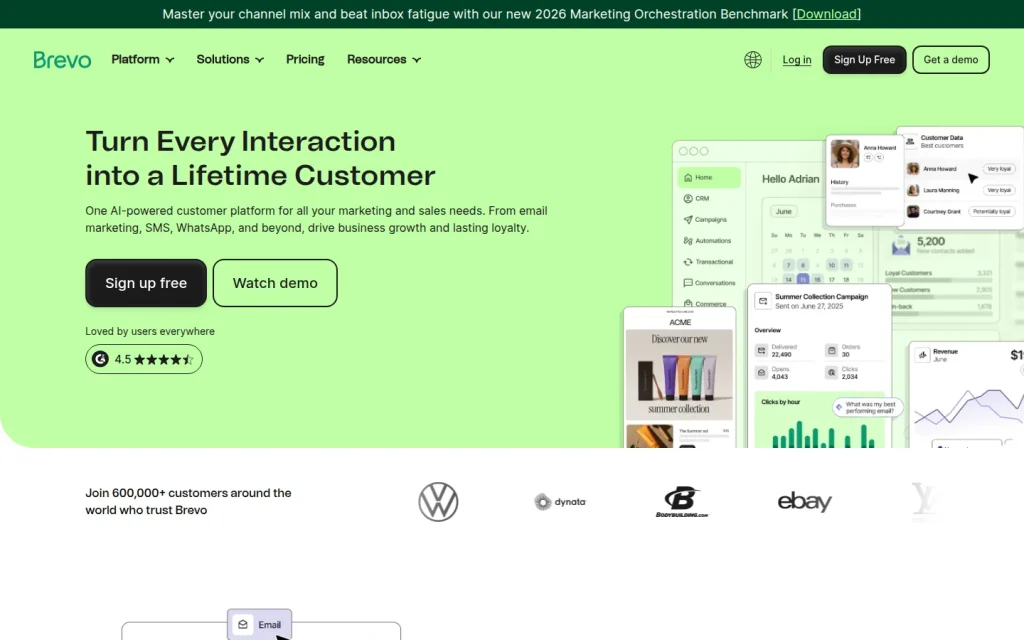
Brevo (formerly Sendinblue) is a certified Magento Technology Partner with an official, maintained plugin on the Magento marketplace. For brands that need a capable multi-channel platform — email, SMS, live chat, basic CRM — without the cost of Klaviyo or the complexity of Dotdigital, Brevo competes on value in a way few platforms do.
Magento integration: The official Brevo plugin for Magento 2 syncs customer and order data, supports abandoned cart and post-purchase automations, and is regularly maintained by the Brevo team. It’s not the deepest integration in this list, but it’s solid, well-documented, and doesn’t require developer involvement to set up.
What makes Brevo different
The price-to-feature ratio. Brevo’s paid plans start at $9/month, and the feature set at that level — visual automation builder, A/B testing, dynamic content, transactional email, SMS — is genuinely competitive. For brands under $5M revenue that need to run a real email program without a real email budget, Brevo removes the “we can’t afford Klaviyo yet” objection.
The CRM functionality is also worth noting. Brevo bundles basic CRM contact management alongside email, which removes the need for a separate tool at early stages.
Where it falls short: Ecommerce automation depth is noticeably below Omnisend and Klaviyo. Revenue attribution reporting is weaker, segmentation conditions are less granular, and the platform’s ecommerce focus is less defined. For a 7-figure brand with an active retention program, Brevo will become limiting.
Pricing: Brevo prices by email sends per month, not by contact count — an important structural difference from most platforms. You can store up to 100,000 contacts on the free plan (300 emails/day limit). The Starter plan begins at $9/month for 5,000 emails/month with no daily cap; the Business plan starts at $18/month for 5,000 emails and adds A/B testing, landing pages, and advanced reporting. Annual billing saves approximately 10%.
Best for: Magento stores under $5M revenue that need a capable, low-cost entry point into email marketing with a solid Magento integration.
| Magento integration | Official plugin (Magento Marketplace) |
|---|---|
| Starting price | Free / $9/mo paid |
| Email + SMS | Yes |
| Ecommerce-native | Partially |
Pros
- ✓ Official, maintained Magento plugin — easy to install, reliable
- ✓ Very competitive pricing — strong value at low to mid send volumes
- ✓ Multi-channel in one platform (email, SMS, chat, CRM)
- ✓ Solid transactional email capability
Cons
- ✗ Ecommerce automation is less sophisticated than Omnisend or Klaviyo
- ✗ Revenue attribution and behavioral segmentation are weaker
- ✗ Guest customer tracking is incomplete — a notable gap for Magento stores with high guest checkout rates
- ✗ Custom field mapping to Brevo contact properties has documented failures
- ✗ Multi-store Magento configurations are not reliably supported
- ✗ Deliverability concern: Brevo’s spam rate benchmarks at ~27.4% versus a ~14.8% industry average — meaningful for merchants where abandoned cart and transactional emails are business-critical
- ✗ Will become limiting for any serious 7-figure+ retention program
5. ActiveCampaign — Best for Brands with Complex Journeys Beyond Purchase Behavior

ActiveCampaign is a marketing automation and CRM platform first, an ecommerce email tool second. That distinction matters. If your customer lifecycle involves more than triggered purchase events — subscription billing, B2B sales motions, complex onboarding, lead scoring — ActiveCampaign’s automation logic is best-in-class. If you primarily need clean, ecommerce-native flows, it’s not the right fit.
Magento integration: ActiveCampaign connects to Magento via its native integration and third-party connectors. It syncs customer and order data, but the connection is less native than Omnisend or Klaviyo — it requires more configuration to get right and more maintenance to keep right.
What makes ActiveCampaign different
The automation builder. ActiveCampaign’s visual workflow logic is more powerful and flexible than any other platform on this list — conditional branches, lead scoring, multi-dimensional if/then logic, CRM pipeline triggers. For brands that need automation that goes beyond what happened in the cart, this flexibility is worth the setup investment.
The built-in CRM also keeps sales and marketing in one system, which matters for B2B ecommerce brands managing account relationships alongside transactional volume.
Where it falls short: ActiveCampaign’s ecommerce-specific features — product blocks, revenue attribution, behavioral segmentation around purchase data — are less developed than Omnisend or Klaviyo. The Magento integration is more fragile and less feature-complete. For a DTC brand running standard ecommerce flows, the added complexity isn’t worth the tradeoff.
Pricing: No free plan — 14-day trial only. Starter plan from $15/month (annual billing) or $19/month (monthly) for up to 1,000 contacts. Scales by contact count: $79/month at 5,000 contacts, $149/month at 10,000 (annual rates). Note: since November 2025, ActiveCampaign charges for all contacts in your account including unsubscribed — a meaningful cost driver at larger list sizes.
Best for: B2B ecommerce, subscription brands, or merchants with complex customer lifecycles that extend beyond standard purchase-event triggers.
| Magento integration | Native integration + third-party connectors |
|---|---|
| Starting price | ~$15/mo |
| Email + SMS | Yes |
| Ecommerce-native | No |
Pros
- ✓ Best-in-class automation builder for complex logic and conditional sequences
- ✓ Built-in CRM — no separate sales tool needed
- ✓ 1,000+ integrations
- ✓ Strong customer support
Cons
- ✗ Not built for ecommerce — ecommerce features are add-ons, not core functionality
- ✗ No native browse abandonment tracking for Magento
- ✗ No AI product recommendations for Magento (Shopify and WooCommerce only)
- ✗ Magento integration requires more setup and maintenance than native ESPs
- ✗ Heavy for teams that just need clean ecommerce email
6. Drip — A Solid Ecommerce-Only Alternative
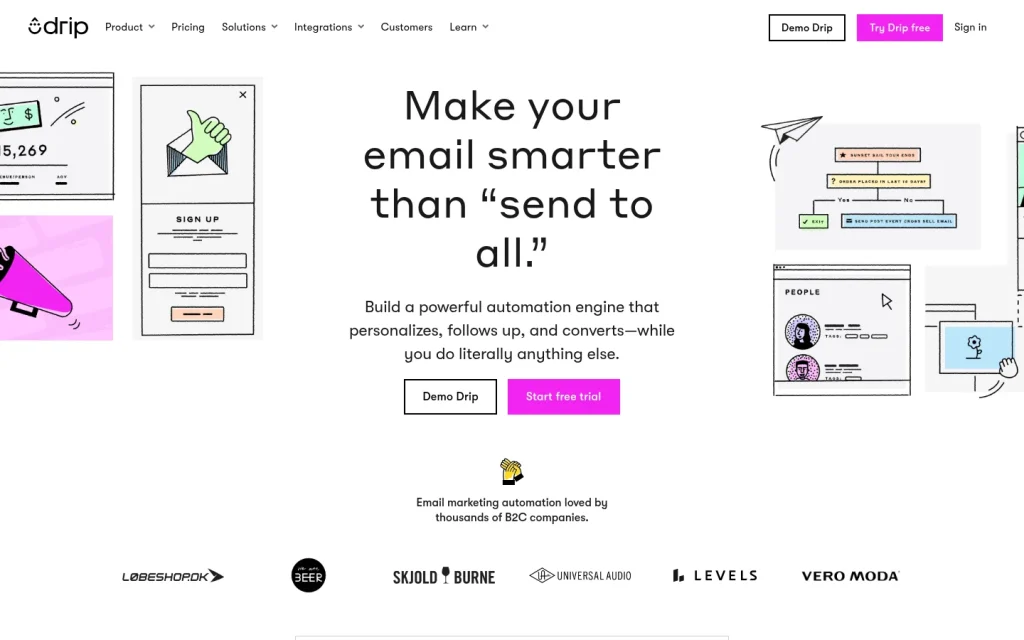
Drip occupies similar positioning to Omnisend — ecommerce-only focus, built for DTC brands, strong automation and segmentation — but with a different UI, a different pricing structure, and a less developed Magento integration story. It’s a capable platform that regularly shows up in ecommerce email comparisons, but for Magento specifically, the lack of a native integration is a real friction point.
Magento integration: Drip connects to Magento via API and third-party connectors. There’s no official Magento marketplace extension, which means integration setup is more involved and ongoing maintenance requires more developer involvement than platforms with native connections.
What makes Drip different
Drip’s segmentation and personalization capabilities are strong, and the platform has a clean, modern UI that some operators prefer over Klaviyo’s density. Revenue attribution and ecommerce reporting are solid. For Shopify brands, Drip is an excellent choice. For Magento brands, the integration complexity is a meaningful disadvantage.
Pricing: No free plan — 14-day trial only. Single plan (all features included regardless of tier): $39/month for up to 2,500 contacts, $89/month at 5,000, $154/month at 10,000, $349/month at 25,000. Unlimited email sends up to ~32,500 contacts; sending caps apply above that threshold. Higher starting point than Omnisend for comparable features.
Best for: DTC brands already considering Drip for platform reasons, or brands migrating from Shopify to Magento with existing Drip infrastructure they want to preserve.
| Magento integration | API / third-party (no native extension) |
|---|---|
| Starting price | ~$39/mo |
| Email + SMS | Yes |
| Ecommerce-native | Yes |
Pros
- ✓ Ecommerce-native focus with strong automation and segmentation
- ✓ Clean, modern interface
- ✓ Solid revenue attribution and reporting
Cons
- ✗ No native Magento integration — more complex and costly to set up correctly
- ✗ Higher starting price than Omnisend for comparable features
- ✗ Smaller agency and developer ecosystem than Klaviyo
7. Mailchimp — Included for Completeness, Not Recommended
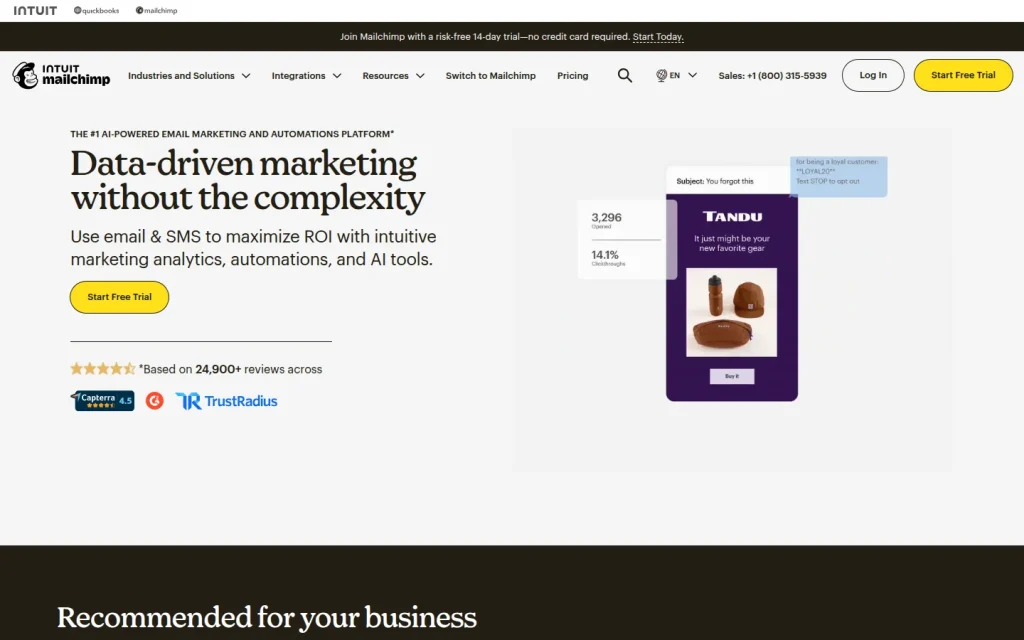
Mailchimp is the most recognized name in email marketing. It is not the right platform for a serious Magento operation, and most agency practitioners will tell you the same. We’re including it because it comes up in every comparison, and the reasons to skip it are worth stating clearly.
Magento integration: Mailchimp’s Magento integration runs through third-party extensions — it is not natively maintained by Mailchimp. Data sync is limited, connection reliability varies by extension, and meaningful issues require developer intervention to diagnose and fix. Compare this to Omnisend’s module (which we built and maintain) or Klaviyo’s marketplace extension, and the gap is significant.
What holds it back
Mailchimp was built for newsletters, not ecommerce automation. Its behavioral segmentation is limited, its ecommerce flows are basic, and its revenue attribution reporting is underdeveloped compared to every other platform on this list. Klaviyo and Omnisend have spent years building purpose-built ecommerce functionality that Mailchimp has not kept pace with.
At very low contact counts, Mailchimp’s free plan is accessible. Beyond that entry point, better options exist at similar or lower price points. One billing gotcha worth noting: Mailchimp counts unsubscribed contacts toward your contact limit — unlike most platforms that only bill for active subscribers — which inflates your tier faster than expected.
Pricing: Free plan up to 250 contacts, 500 emails per month. Essentials from $13/month (500 contacts). Standard from $20/month (500 contacts) — this is where multi-step automations unlock.
Best for: Magento stores in the early stages — under $500K revenue — that need the simplest possible tool and have no immediate plans to build out lifecycle automation.
| Magento integration | Third-party extensions only |
|---|---|
| Starting price | Free / $13/mo |
| Email + SMS | No |
| Ecommerce-native | No |
Pros
- ✓ Easy to learn and use
- ✓ Free entry point for very small lists
- ✓ Widely recognized — easy to find freelance help
Cons
- ✗ Magento integration is fragile and requires third-party maintenance
- ✗ Documented bug: customers with accounts who check out as guests receive no abandoned cart emails — a known issue with no fix
- ✗ No multi-store support without custom development
- ✗ Unsubscribed contacts count toward your contact limit — inflates tier cost faster than expected
- ✗ Ecommerce automation and segmentation are significantly behind purpose-built tools
- ✗ Not scalable for a real retention marketing program
Quick Comparison: Magento Email Marketing Platforms
| Platform | Magento Integration | Ecommerce-Native | Email + SMS | Starting Price | Best For |
|---|---|---|---|---|---|
| Omnisend | Free module (Enflow Digital) | Yes | Yes | Free / $16/mo (Standard) | Most Magento brands |
| Klaviyo | Native extension (Marketplace) | Yes | Yes | Free / $20/mo (500 contacts) | Large lists, analytics-heavy |
| Dotdigital | Platinum Partner — deepest native | Partially | Yes | ~$500/mo (quote-based) | Enterprise / Adobe Commerce |
| Brevo | Official plugin (Marketplace) | Partially | Yes | Free / $9/mo (5K sends) | Budget all-in-one |
| ActiveCampaign | API / third-party | No | Yes | $15/mo annual (1K contacts) | Complex journeys, B2B |
| Drip | API / third-party | Yes | Yes | $39/mo (2.5K contacts) | DTC alternative |
| Mailchimp | Third-party extensions only | No | No | Free / $13/mo (Essentials) | Early-stage only |
Our Recommendation
For most Magento merchants — particularly those running 7-figure stores and above — Omnisend is the strongest option. It’s ecommerce-native, covers email and SMS in one platform, and the free module we’ve built removes the one legitimate barrier that existed for Magento users. At similar list sizes, it’s meaningfully less expensive than Klaviyo while delivering comparable automation depth for standard ecommerce flows.
If your store is running on Adobe Commerce at enterprise scale, has multiple storefronts, or has B2B complexity baked into the Magento architecture, Dotdigital’s Platinum partnership makes it worth the investigation. No other platform has a deeper native integration.
If your team is analytically sophisticated, your list is large, and you’ll genuinely use predictive LTV segmentation and churn risk modeling as inputs to your program — Klaviyo’s premium is justified. If you won’t use those features, you’re paying for them anyway.
Everything else is situational. Brevo is a reasonable starting point for stores that aren’t ready for Omnisend’s pricing. ActiveCampaign makes sense if your lifecycle is genuinely complex in ways that go beyond purchase behavior. Drip is a viable Omnisend alternative if you’re already in the ecosystem.
Mailchimp is not a serious retention marketing tool for a Magento store doing meaningful volume.
Frequently Asked Questions
Does Magento have built-in email marketing?
Magento handles transactional emails natively — order confirmations, shipping notifications, account registration, and similar system-generated messages. It does not include marketing automation, behavioral triggers, segmentation, abandoned cart flows, or any of the lifecycle marketing infrastructure that drives repeat purchase revenue. For that, you need a dedicated email marketing platform connected to your Magento store.
Does Omnisend integrate with Magento?
Yes. Omnisend’s own native Magento plugin is no longer supported, but Enflow Digital has built and maintains a free replacement module for Magento 2.4.x. The module handles full customer sync, real-time order and cart event tracking, product catalog sync, and JavaScript tracking injection — everything you need to run Omnisend’s full automation suite from your Magento store. You can get it at enflowdigital.com/services/omnisend-magento-integration.
What’s the best email marketing platform for Magento?
For most 7–9 figure Magento brands, Omnisend is the strongest combination of ecommerce depth, integration quality, and price. For enterprise Adobe Commerce operations, Dotdigital’s Platinum Technology Partner status gives it the deepest native integration. For brands with complex analytics requirements and large lists, Klaviyo’s predictive data layer is worth the premium.
Does Klaviyo work with Magento?
Yes. Klaviyo has a native Magento 2 extension available on the Adobe Commerce Marketplace. It syncs contacts, order history, catalog data, and behavioral events, and is actively maintained. Of the platforms with native Magento integrations, Klaviyo’s is one of the more reliable options.
What happened to Omnisend’s Magento plugin?
Omnisend deprecated their native Magento plugin in 2021, leaving Magento merchants without a first-party integration option. Enflow Digital — as an Omnisend partner agency — built a free replacement module for Magento 2.4.x to fill that gap. It’s available at no cost with full setup documentation, and paid installation support is available for merchants who need it.
The Bottom Line
Magento handles complexity at scale. Your email platform should too. Native Magento email is transactional infrastructure — it keeps orders flowing, not customers returning.
The platform you choose determines whether your existing customer base is a revenue asset or a list of contacts you’ve already paid to acquire and aren’t using. For most Magento merchants, Omnisend is the right starting point: ecommerce-native, affordable, and now fully accessible through the free module we’ve built.
If you want it set up properly — configured, tested, and integrated with your Magento store from day one — or if you want a full email program built and run for your brand, that’s the work we do at Enflow Digital.
We work with 7–9 figure Magento brands on email strategy, flow implementation, campaign management, and lifecycle programs. If your email revenue isn’t where it should be, book a free strategy call and we’ll show you exactly where the gap is.
Or if you just need the Omnisend module — get it here.